Education


A Simple Approach

Evaluating a corneal GP doesn’t have to be complicated. Start by allowing the lens to settle for at least five minutes before evaluating the fit.

Then assess movement, fluorescein pattern, vision, and comfort.

Simply send your findings to Consultation so they can make any necessary adjustments.

Evaluation

  • Movement: Ideally, the lens should lift with the upper lid at blink, and drop to a centered position immediately following the blink.
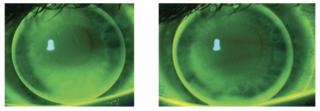
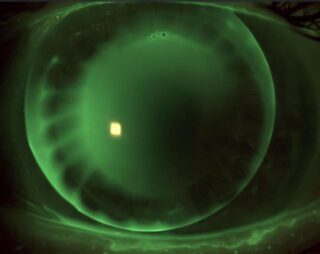
  • Fluorescein Pattern: Evaluate the fluorescein pattern and note any areas of touch, or excessive pooling. Some pooling is acceptable, so long as there are no bubbles and visual acuity is good.
  • Corneal Staining: Remove the lens and evaluate the cornea for any staining.
  • Vision and Comfort: Note the patient’s visual acuity, over-refraction, and over-all comfort.

If possible, sending photos or videos of the lens on-eye are extremely helpful for the consultants when refining the fit.

Dispensing

Once the fit, vision, and comfort are acceptable:

  • Provide insertion and removal training.
  • Have the patient watch the insertion and removal videos before practicing.
  • Set the expectation regarding the adaptation period.
  • Provide written care instructions, including approved solutions and where they can be purchased.
  • Schedule the recommended follow-up visits.

Need help with a fit?
Our Consultation Team is available to review your findings and help determine the next step.

CONSULTATION: 800-223-1858
EMAIL: info@metro-optics.com

Learn more: When to Fit a Corneal GP

Sincerely,
Your Metro-Optics Team


Dr. H NaCl patter RSb

Practice: Illinois College of Optometry
Patient: 86 YO Female
Condition: Keratoconus, s/p PKP OS

Presentation:
Patient has a history of long term corneal GP wear for keratoconus. She presented for new corneal GPs after undergoing cataract surgery and a corneal transplant OS.

Ocular History:
Keratoconus, cataract surgery OD, cataract surgery OS, dry eye disease, allergic conjunctivitis, s/p PKP OS.

Prescribed Lenses:
RSB OS

The RSb Lens is our post-refractive surgery lens, reverse geometry configuration.
Learn more

Outcome:
Patient was 20/200 with her glasses and with the RSB lens, her VA improved to 20/25+. She is thrilled with her VA and improvement in quality of VA.

Help More Patients in Your Area:
Find the Illinois College of Optometry on our Physician Locator page as a specialty contact lens practice. Is your practice on the map? Check here.


Dr. Shelby Gross

Optometrist: Shelby Gross, OD
Practice: Heights Vision Specialists
Patient: 78 YO Male
Condition: Post LASIK & Cataract

Presentation:
OD: -4.00 -2.50 x 090
OS: – 0.75 -0.75 x 045 

Patient doesn’t want to wear glasses, “Anything but Glasses.” Conventional lenses aren’t working for him. He has difficulty seeing his lenses and ends up poking his eye when trying to insert them. 

Ocular History:
LASIK and cataract surgery OU. Patient had a retina detachment with a scleral buckle in his right eye. Severe dry eye.

Prescribed Lenses:
RSb front toric lens OD for monovision. Dr. Gross started him on a therapeutic regimen to optimize the ocular surface.We selected a well tinted corneal GP to assist in handling the lens during insertion.

OD: -4.00 -3.50 x 090

The RSb Lens is our post-refractive surgery lens, reverse geometry configuration.
Learn more

Outcome: BCVA 20/20
He is very happy with the outcome.

Help More Patients in Your Area:
Find Heights Vision Specialists on our Physician Locator page as a specialty contact lens practice. Is your practice on the map? Check here.


Simple & Straightforward

Fitting corneal GPs is easier than you think. Getting started is easy – no diagnostic fit set is required for most Metro Optics GP lens designs.

Note: Keratoconus can be fit empirically, but chair time is reduced by using a diagnostic set. We offer a complimentary ComfortKone Quick Fit Set. Learn more here.

Order GP lenses empirically, without any lens design calculations. Simply send the following patient information to consultation.

Exam Information

  • Corneal Topography
  • Keratometry Readings (Auto-K works well)
  • Manifest Refraction
  • Pertinent Patient History (surgery, trauma, past contact lens wear)

This information helps us understand the corneal shape & curvatures we are attempting to fit. If you don’t have a topographer, that’s okay!

GP Lens Designs

All major brand materials are available including Hyper Dk materials.

  1. Standard Spherical GP
    Less than 3.00D Astigmatism
  2. Specialty GP Designs
    Toric lens options: base, front surface, bi-toric designs
  3. Metro Progressive Multifocal GP
    Presbyopic patients
    Up to 3.00D ADD

sphere (left) versus toric (right)
Spherical Lens on Left & Toric Lens on the Right

4. MetroSeg Translating Bifocal GP
Segmented Bifocal
Up to 3.00D ADD
5. RSa or RSb Post – Surgical GP
Post-surgical lens
Vaults central corneal irregularity

RS stands for Refractive Surgery
RSa: Spherical configuration
RSb: Reverse geometry configuration

Hydra-PEG

You have the option to Hydra PEG the lens which is a 90% water PEG (polyethylene glycol) coating that is covalently bonded to the surface of the lens. Hydra PEG improves wettability, comfort and clarity.
Learn more

Do What You Can

If you don’t have all the information listed above, don’t worry! Our experienced consultants can design a lens based on the details you provide. The more accurate information we receive, the faster we can get the final lens to you.

We are here to support you every step of the way!

Sincerely,
Your Metro-Optics Team

CONSULTATION: 800-223-1858
EMAIL: info@metro-optics.com


Dr. Kat Eye Society

Optometrist: Dr. Katherine Tran, O.D.
Practice: Eye Society, Houston, TX
Patient: 30 YO Female
Condition: Severe Dry Eye Disease

Presentation:
Patient presented with extreme dry eye and was previously advised against wearing contacts. She expressed a preference for contacts over glasses.

Ocular History:
The patient is a high myope with bilateral astigmatism. She can only count fingers without correction.
OS: -6.00 -1.00 x 031
OD: -6.25 -0.75 x 145

Vision: 20/400 OU

Prescribed lenses:
Standard GP Sphere in Optimum Infinite Blue, a hyper-Dk material, delivering 180 Dk, with Hydra-PEG surface treatment to optimize wettability and comfort.
Learn more here

Outcome:
OU BCVA: 20/20

The patient loved the lenses immediately! She was thrilled to experience clear vision and was excited that she could wear contacts. She comfortably wears her contacts for 10 hours a day, & her dry eye symptoms have improved.

Help More Patients in Your Area:
Find Eye Society on our Physician Locator page as a specialty contact lens practice. Is your practice on the map? Check here.


Are you looking to offer specialty contact lenses for patients who can’t achieve their best vision with glasses or daily contacts?

Metro Optics’ innovative portfolio enables eye care professionals to source high-quality custom contact lenses, ranging from  mild prescriptions to high-cylinder patients, and even the most hard-to-fit eye conditions.

6 Steps to Success

  1. Network: Spread the word about your services. Reach out to fellow physicians, other specialists, hospitals, and professionals locally and online. Get to know your business neighbors, ask if you can bring literature to their practice, and ask questions about their demographics. Talk to realtors, hair stylists, church members, pickleball league buddies, your child’s friends’ parents—everyone!
  2. Staff Education: Educate your staff with the abundance of free resources on YouTube, the GPLI webinars, and Scleral Lens education Society. Empower staff by getting familiar with ocular conditions, lens modalities, and billing. Schedule lunch and learns with your local reps to learn more about each company and their lens designs. Register your account in the Physician Portal to access Insertion and Removal video tutorials.
  3. Questionnaire: Ask your patients questions about their vision, comfort, dryness, and satisfaction with their current contacts. Often, patients won’t bring up issues unless prompted, assuming their vision is as good as it can be. The doctor can address their answers during the visit.
  4. Patient Education: Offer educational resources for your patients, such as concise one-page handouts that outline the benefits of custom contact lenses. Including information on their options, the proper care systems,  solutions and where to purchase them can enhance patient compliance and over all ocular health.
  5. Leverage Your Labs: Don’t hesitate to ask your labs questions. They are a valuable resource with insights and expertise. Each lab may offer different perspectives on lens modalities, designs and strategy. Let technology do the heavy lifting! Send images to your consultants at info@metro-optics.com to optimize the fitting session.
  6. Current content: Actively updating content on your website and social media profiles helps your ideal patient find your practice when they search online. If your website includes content that addresses their ocular condition, they will be more likely to schedule an appointment with you. Offer resources for them to connect with other people with their condition. For example https://nkcf.org for your Keratoconus patients.

When patients see that you genuinely care about providing the best possible vision rather than just settling for the status quo, they will trust and invest in you because you’ve invested in them. While some patients may be content with their current vision, others will be thrilled that you’ve given them a better option.

Education is powerful. By offering all available options to your patients, you enable them to make informed decisions, enhancing their overall experience and satisfaction.


What is the ComfortKone Lens?
ComfortKone is an FDA Cleared RGP contact lens design for Keratoconus applications. The ComfortKone Aspheric is the most advanced lens for patients in any stage of Keratoconus. This unique lens design provides consistent results with maximum comfort and visual acuity for keratoconus patients.

What does FDA Clearance mean?
The ComfortKone lens design holds an FDA 510k clearance specifically for Keratoconus application. This means that Metro Optics submitted lens design and patient case information to the FDA demonstrating safety and efficacy of the lens on keratoconic corneas.

What is special about the ComfortKone?
This design uses a corneal alignment fitting approach to maximize comfort and visual acuity. The design features a comprehensive fitting system with controlled parameters that provide quick and consistent results, and the computer driven manufacturing systems used to create the ComfortKone ensures that every lens and fit is completely reproducible.

What are the design specifics?
The back surface of the ComfortKone lens is begins with a central spherical base curve zone which vaults over the corneal apex. It
transitions to an aspheric zone creating an alignment to the keratoconic slope. This base curve configuration causes the lens to center itself over the cone which is usually a bit off corneal center, and does not adversely affect vision or comfort. The back surface peripheral curves are similar to standard lens designs to provide maximum edge comfort and tear exchange under the lens. The front surface of ComfortKone can feature both spherical and toric optics.

Base Curve Evaluation
Slit-lamp evaluation of the lens will quickly reveal any necessary changes. After allowing the lens to settle for several minutes, instill fluorescein and use blue cobalt light with a wratten filter. The wratten filter will overcome the UV inhibitors present in the lens material so you can clearly see the tear film behind the lens. Note any areas of touch or excessive clearance from the lens center to edge. Send
photos and videos of the fluorescein patterns to your Metro Optics consultant. Be sure to use a wratten filter over the camera lens when capturing images.

Over-Refraction
The most accurate method for determining lens power for any keratoconus patient is to over refract over the best fitting diagnostic lens. This should be done following lens settling and base curve evaluation. A spherocylindrical over-refraction should be taken as the ComfortKone lens is available in toric optics.

What about empirical fitting of ComfortKone?
Although this not the ideal approach, a ComfortKone lens can be designed empirically with the aid of keratometry readings or corneal topography and manifest refractions with the help of a Metro Optics fitting consultant.

Learn More here about the ComfortKone design and our other Keratonus lens options.


All rights reserved. | Quality Terms & Conditions