Education


A Simple Approach

Evaluating a corneal GP doesn’t have to be complicated. Start by allowing the lens to settle for at least five minutes before evaluating the fit.

Then assess movement, fluorescein pattern, vision, and comfort.

Simply send your findings to Consultation so they can make any necessary adjustments.

Evaluation

  • Movement: Ideally, the lens should lift with the upper lid at blink, and drop to a centered position immediately following the blink.
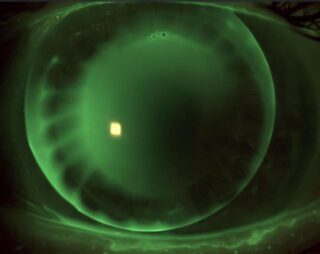
  • Fluorescein Pattern: Evaluate the fluorescein pattern and note any areas of touch, or excessive pooling. Some pooling is acceptable, so long as there are no bubbles and visual acuity is good.
  • Corneal Staining: Remove the lens and evaluate the cornea for any staining.
  • Vision and Comfort: Note the patient’s visual acuity, over-refraction, and over-all comfort.

If possible, sending photos or videos of the lens on-eye are extremely helpful for the consultants when refining the fit.

Dispensing

Once the fit, vision, and comfort are acceptable:

  • Provide insertion and removal training.
  • Have the patient watch the insertion and removal videos before practicing.
  • Set the expectation regarding the adaptation period.
  • Provide written care instructions, including approved solutions and where they can be purchased.
  • Schedule the recommended follow-up visits.

Need help with a fit?
Our Consultation Team is available to review your findings and help determine the next step.

CONSULTATION: 800-223-1858
EMAIL: info@metro-optics.com

Learn more: When to Fit a Corneal GP

Sincerely,
Your Metro-Optics Team


Maximum Astigmatism

MetroSoft Max stands for “maximum astigmatism,” ideal for your patients whose visual needs can’t be met with glasses or standard daily contact lenses.

Lens Parameters

The MetroSoft Max can correct up to 8.00D of astigmatism, and we deliver the lenses to you in about a week.

Base curve: 8.1 to 8.9 depending on material
Power: -12.00 to +12.00
Diameter: 14.0, 14.2 depending on lens design
Prism: 1 Diopter

Extended parameters are available.

Ideal Patient

Any astigmatic case with up to 8.00 diopters of corneal cylinder.

Stable Vision

The Metro Soft Max is indicated  for patients with 2.00D or more of corneal astigmatism. The cylinder correction is incorporated into the back surface of the lens, which aligns with the irregular curvature of the cornea.

This results in a “saddle-fit,” which stabilizes the lens on the cornea, improving comfort and VA compared to a spherical contact lens.

Latheable Materials

Our soft contact lens line is available in three materials, listed below. Our consultants will work with you to determine the best material for your patient, with ocular surface health as our top priority.

  1. Polymacon: 38% water standard hydrogel
  2. Hioxyfilcon-B: 49% water standard hydrogel
  3. Definitive SiHy Efrofilcon-A: 74% water, 60 Dk (first latheable Silicone Hydrogel Material)
    Learn More

Replacement schedule

Planned replacement is at the discretion of the doctor. The life of the lens will depend on how well the patient cares for the lenses. Multi-packs are available up to annual supply.

Education

“You can wear contacts!” We’re here to help you educate your patients about all of their contact lens options.

CONSULTATION: 800-223-1858
EMAIL: info@metro-optics.com


Keratoconus, intacs, crosslinking, ICO

Practice: Illinois College of Optometry
Patient: 52 YO Female
Condition: Keratoconus, s/p intacs OD

Presentation:
Patient was diagnosed with keratoconus over 20 years prior. She had intacs and corneal cross linking OD. Her goal was to stay in soft contact lenses if possible.

Ocular History:
Keratoconus, intacs, corneal cross linking, ocular allergies

Prescribed Lenses:
Kerasoft IC STD
Learn more

Outcome:
20/20 OD
20/20-1 OS
Patient reports great vision and comfort all waking hours of day. She spends 8-10 hours per day on the computer and has no difficulties with lens wear.

Help More Patients in Your Area:
Find the Illinois College of Optometry on our Physician Locator page as a specialty contact lens practice. Is your practice on the map? Check here.


Dr. H NaCl patter RSb

Practice: Illinois College of Optometry
Patient: 86 YO Female
Condition: Keratoconus, s/p PKP OS

Presentation:
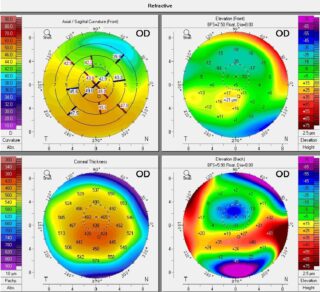
Patient has a history of long term corneal GP wear for keratoconus. She presented for new corneal GPs after undergoing cataract surgery and a corneal transplant OS.

Ocular History:
Keratoconus, cataract surgery OD, cataract surgery OS, dry eye disease, allergic conjunctivitis, s/p PKP OS.

Prescribed Lenses:
RSB OS

The RSb Lens is our post-refractive surgery lens, reverse geometry configuration.
Learn more

Outcome:
Patient was 20/200 with her glasses and with the RSB lens, her VA improved to 20/25+. She is thrilled with her VA and improvement in quality of VA.

Help More Patients in Your Area:
Find the Illinois College of Optometry on our Physician Locator page as a specialty contact lens practice. Is your practice on the map? Check here.


Simple & Straightforward

Fitting corneal GPs is easier than you think. Getting started is easy – no diagnostic fit set is required for most Metro Optics GP lens designs.

Note: Keratoconus can be fit empirically, but chair time is reduced by using a diagnostic set. We offer a complimentary ComfortKone Quick Fit Set. Learn more here.

Order GP lenses empirically, without any lens design calculations. Simply send the following patient information to consultation.

Exam Information

  • Corneal Topography
  • Keratometry Readings (Auto-K works well)
  • Manifest Refraction
  • Pertinent Patient History (surgery, trauma, past contact lens wear)

This information helps us understand the corneal shape & curvatures we are attempting to fit. If you don’t have a topographer, that’s okay!

GP Lens Designs

All major brand materials are available including Hyper Dk materials.

  1. Standard Spherical GP
    Less than 3.00D Astigmatism
  2. Specialty GP Designs
    Toric lens options: base, front surface, bi-toric designs
  3. Metro Progressive Multifocal GP
    Presbyopic patients
    Up to 3.00D ADD

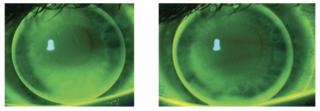
sphere (left) versus toric (right)
Spherical Lens on Left & Toric Lens on the Right

4. MetroSeg Translating Bifocal GP
Segmented Bifocal
Up to 3.00D ADD
5. RSa or RSb Post – Surgical GP
Post-surgical lens
Vaults central corneal irregularity

RS stands for Refractive Surgery
RSa: Spherical configuration
RSb: Reverse geometry configuration

Hydra-PEG

You have the option to Hydra PEG the lens which is a 90% water PEG (polyethylene glycol) coating that is covalently bonded to the surface of the lens. Hydra PEG improves wettability, comfort and clarity.
Learn more

Do What You Can

If you don’t have all the information listed above, don’t worry! Our experienced consultants can design a lens based on the details you provide. The more accurate information we receive, the faster we can get the final lens to you.

We are here to support you every step of the way!

Sincerely,
Your Metro-Optics Team

CONSULTATION: 800-223-1858
EMAIL: info@metro-optics.com


What Information Do You need to order an InSight Scleral Lens?

Our methodology focuses on simplicity and optimizing your chair time. Provide us with your observations, and we’ll handle the lens parameters.

If you can place a diagnostic lens on the eye with sodium fluorescein (NaFl), note your observations, we can deliver an initial lens within a few days.

Corneal and scleral GP lenses typically take 2–3 days to manufacture; Hydra-PEG adds one day to the process. Standard shipping is 2-3 business days.

Checklist for Simplified Ordering:

1. Initial Lens Selection
Based Selection on Sagittal Height
This reflects the overall curvature of the cornea.

  • Steep/Ectatic Corneas: Start with the Prolate 5.000 SAG
  • Flatter/Oblate Corneas: Select the Oblate 4.750 SAG

2. Evaluation (Three Steps)

  1. Central Clearance:
    Aim for ~250 microns of clearance, represented by a 1:1 ratio—250 microns of post-lens tear film and 250 microns of lens center thickness.
  2. Peripheral Clearance:
    Ensure NaFl clears the limbus 360° with 50–80 microns of peripheral clearance. Look for any areas of bearing or blanching; the limbus should always be vaulted.
  3. Edge Alignment:
    The lens should sit comfortably on the conjunctiva. Check for signs of impingement or blood vessel constriction.

    Please send images or short 2-3 second videos of the lens on the eye.

    Quick Tip:
    After lens removal, check for staining and report it to consultation if present.

3. Patient Feedback

Ask the patient how the lens feels:

  • Lens Awareness: If the patient feels the lens, it’s likely a landing issue.
  • Discomfort: If the lens is uncomfortable, remove it immediately. Scleral lenses should be very comfortable.

4. Topography:

Provide topographical data for consultation—it gives a clearer picture for customized lens fitting.

5. Anterior Segment OCT (Optional):

If available, AS-OCT images offer additional data to help understand what is happening with the lens on the eye, though it is not required.

6. HVID (Horizontal Visible Iris Diameter):

This measurement is essential for incorporating multi-focal optics, optimizing visual acuity and customizing the lens to the patient’s lifestyle.

7. Sphere-Cylinder Over-Refraction:

The SCOR provides the most accurate visual acuity and avoids inducing astigmatism. The InSight Scleral Lens can incorporate up to +3.00 D of ADD power.

8. Pertinent Patient Information:

Provide details such as:

  • Previous contact lens wear
  • Surgical procedures
  • Visual demands
  • Any factors that could significantly impact the lens design

9. Hydra-PEG (Optional):

Ask during consultation if Hydra-PEG is suitable for the patient.
Hydra-PEG Benefits:

  • Improves wettability by lowering the wetting angle
  • Reduces deposits and fogging

Please call consultation with the above information to discuss further, and we will have the lenses to you in a few short days.

If you don’t have all the information listed above, don’t worry! Our experienced consultants can design a lens based on the details you provide. The more accurate information we receive, the faster we can get the final lens to you.

We are here to support you every step of the way!

Sincerely,
Your Metro-Optics Team

CONSULTATION: 800-223-1858
EMAIL: info@metro-optics.com


Bilateral Keratoconus KeraSoft Thin

Patient:24 YO Male College Football Player
Condition: Bilateral Keratoconus

Ocular History:
Undetermined manifest refraction due to high corneal irregularity.

Treatment:
Due to high physical activity and poor GP lens tolerance, lens fit was converted to piggy-back system resulting in BCVA 20/50 OU.

Refit in Kerasoft OU with first fit parameters:
• OD BC 8.40, -4.75 -3.75 X 10, Diameter 15.0, Standard peripheral
• OS BC 8.20, -18.25, Diameter 15.0, Standard peripheral

LEARN MORE about KeraSoft
KeraSoft Diagnostic Fit Set

Outcome:
Dispense visit over-refraction:
• OD +1.25 -1.00 X 45 for 20/20 minus
• OS Plano for 20/20 minus

Remade OD with new lens power
-3.75 -4.50 X 65

Shortly following lens dispense, patient was recruited to a professional practice squad, relocated, and neglected follow-up.

Eight months post-dispense

  • Patient reaches out to report a drop in visual acuity.
  • The patient was instructed to report to the practitioner’s office at their earliest convenience for evaluation.
  • Upon evaluation, Kerasoft lenses exhibit excessive movement along with small over-refraction.
  • This decline in lens performance is due to lenses being used beyond their effective duty cycle.
  • The patient is informed that Kerasoft lenses must be replaced at a recommended 3-month interval.
  • The lenses can perform adequately for up to 6 months, but material degradation will result in poor performance beyond that time.
  • New Kerasoft lenses were ordered in the original parameters and in multi-packs.
  • Original dispense lens performance was restored by the new lenses and the patient was scheduled for routine follow-up.

Help More Patients in Your Area:
We want to make it easy for patients to find your practice. Is your practice listed on the map? Check the Physician Locator Page.


What is the ComfortKone Lens?
ComfortKone is an FDA Cleared RGP contact lens design for Keratoconus applications. The ComfortKone Aspheric is the most advanced lens for patients in any stage of Keratoconus. This unique lens design provides consistent results with maximum comfort and visual acuity for keratoconus patients.

What does FDA Clearance mean?
The ComfortKone lens design holds an FDA 510k clearance specifically for Keratoconus application. This means that Metro Optics submitted lens design and patient case information to the FDA demonstrating safety and efficacy of the lens on keratoconic corneas.

What is special about the ComfortKone?
This design uses a corneal alignment fitting approach to maximize comfort and visual acuity. The design features a comprehensive fitting system with controlled parameters that provide quick and consistent results, and the computer driven manufacturing systems used to create the ComfortKone ensures that every lens and fit is completely reproducible.

What are the design specifics?
The back surface of the ComfortKone lens is begins with a central spherical base curve zone which vaults over the corneal apex. It
transitions to an aspheric zone creating an alignment to the keratoconic slope. This base curve configuration causes the lens to center itself over the cone which is usually a bit off corneal center, and does not adversely affect vision or comfort. The back surface peripheral curves are similar to standard lens designs to provide maximum edge comfort and tear exchange under the lens. The front surface of ComfortKone can feature both spherical and toric optics.

Base Curve Evaluation
Slit-lamp evaluation of the lens will quickly reveal any necessary changes. After allowing the lens to settle for several minutes, instill fluorescein and use blue cobalt light with a wratten filter. The wratten filter will overcome the UV inhibitors present in the lens material so you can clearly see the tear film behind the lens. Note any areas of touch or excessive clearance from the lens center to edge. Send
photos and videos of the fluorescein patterns to your Metro Optics consultant. Be sure to use a wratten filter over the camera lens when capturing images.

Over-Refraction
The most accurate method for determining lens power for any keratoconus patient is to over refract over the best fitting diagnostic lens. This should be done following lens settling and base curve evaluation. A spherocylindrical over-refraction should be taken as the ComfortKone lens is available in toric optics.

What about empirical fitting of ComfortKone?
Although this not the ideal approach, a ComfortKone lens can be designed empirically with the aid of keratometry readings or corneal topography and manifest refractions with the help of a Metro Optics fitting consultant.

Learn More here about the ComfortKone design and our other Keratonus lens options.


Health, Happiness & Multifocal Lenses

Metro Optics custom multifocal lenses fill a niche commodity lenses can’t touch.

By using Metro Optics proven presbyopic lens designs, you will realize how simple and rewarding it is to fit custom multifocal contact lenses. 

Metro Optics Multifocal Quick Reference:

Our design portfolio includes soft, corneal GP and scleral lens designs proven to enhance the vision of thousands of presbyopic patients:

MetroFocal  – Center distance soft multifocal, normal cornea profile, up to 2.50D add power, available in toric parameters for patients with 0.75 to 8.00D cornea astigmatism – best suited for the mild to moderate presbyope who desires a soft lens. Empirically order lenses using manifest and keratometry readings. Available in Definitive 74% SiHy, 60 Dk which provides three times the oxygen to the cornea in comparison to other hydrogels (1).

Metro Progressive  – Center distance corneal GP aspheric multifocal, normal cornea profile, up to 2.50D add power, rotation-free optics for patients with less than 2.75D astigmatism, available in back-toric and bi-toric for patients with over 3.00D corneal astigmatism – best suited for the mild-to-moderate presbyope who is a current GP wearer or desires the crispest vision possible in a multifocal design. Empirically order lenses using manifest and keratometry readings.

Metro SEG  – Translating crescent bifocal with an aspheric intermediate zone, normal cornea profile, unlimited add power, available in back toric and bi-toric for patients with over 3.00D cornea astigmatism – best suited for the moderate to advanced presbyope who is a current GP wearer or desires the crispest distance and near vision possible. Empirically order lenses using manifest and keratometry readings.

InSight Scleral – Center distance multifocal scleral, normal to highly irregular cornea profiles, up to 3.00D add power, thin design maximizes Dk/t of the chosen lens material – best suited for the mild to moderate presbyope who needs a medically necessary lens for keratoconus, post-surgical ectasia or severe ocular surface disease. Diagnostic fitting is required with live virtual training available with a Metro Optics consultant.

An Infinitely Better Material for Corneal GP and Scleral Lenses

When it comes to quality, Metro Optics ensures all lenses are manufactured with the best materials available in the market. To provide your patients with the healthiest contact lens environment, it is recommended to choose a high dK/t lens material such as Optimum Infinite, which has a hyper oxygen permeability value of 180Dk and a high flexural modulus of 1341MPa, defying the high Dk/low flexural modulus convention (2). This material also has excellent surface wettability, which can be further enhanced through the addition of Tangible hydra-PEG coating to make Infinite the healthiest choice for your corneal GP and Scleral lens wearers. 

Metro Cares About Your Practice

Other than manufacturing high quality custom lenses, Metro Optics also provides many benefits to ensure our customers have a profitable custom lens practice. We have always offered 90-day warranties on all lens designs, easy return policies, competitive pricing and expertise consultation to finalize fittings quickly. We will also continue to support our customers by extending warranties on fittings performed prior and during the rebuilding phase of the COVID-19 pandemic. Visit our website at metro-optics.com to learn more about our entire line of custom contact lenses.

PUBLISHED IN THE JUNE 2020 CONTACT LENS SPECTRUM ISSUE

References 

  1. https://www.clspectrum.com/issues/2010/november-2010/contact-lens-design-materials)
  2. https://www.contamac.com/product/optimum-infinite



All rights reserved. | Quality Terms & Conditions